A First Visit to an Unfamiliar Ground: Leave Time for the Edges
A first visit to an unfamiliar ground is easier when you plan for the meeting points, quiet pauses and routes around the match, not just your seat.
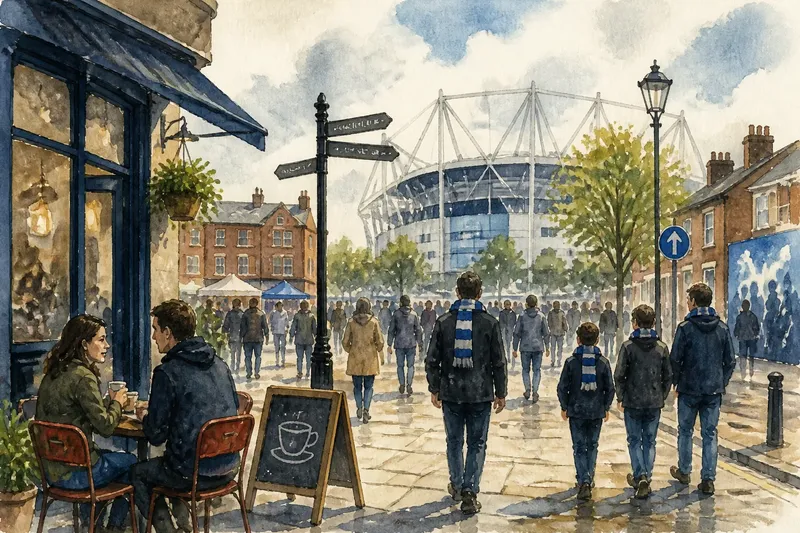
On a first visit to an unfamiliar ground, the turn from an ordinary street into a crowd can happen quickly: a row of scarves appears, traffic slows, and people begin choosing different paths. Leave room to notice what sits around the match as well as the entrance. The useful question is not only how to reach your seat, but where you can pause, meet someone or regain your bearings without making the day feel like a logistical exercise.
Keep the plan light. Decide how you will approach, agree on one meeting point, and allow a little unassigned time before and after the game. The right choices depend on whether you are alone, meeting friends, travelling with someone who needs a gentler pace, or arriving close to kick-off.
Which arrival plan fits your situation?
A venue’s edges include the streets leading towards it, nearby cafés and pubs, public squares, transport stops, bridges, walkways and the spaces where people wait. They may feel busy, quiet, familiar or hard to read. You do not need to visit every place; choose the approach that suits your company and the time you have.
- If you are going alone: Pick a clear landmark near your route, such as a named station exit or a prominent public building. It gives you a simple point to recognise without requiring you to join a group or ask strangers for directions.
- If you are meeting friends: Choose a specific, easy-to-describe spot outside the busiest entrance. “By the north gate” can be ambiguous when people are arriving; a café doorway or a visible corner on a named street is easier to identify.
- If you have plenty of time: Walk one short stretch of the approach before settling somewhere nearby. This lets you see how the streets connect and notice a place to pause later, without turning the visit into a full tour.
- If you are arriving close to kick-off: Go directly towards your entrance and save exploration for after the match. A hurried detour adds pressure and may leave you trying to interpret an unfamiliar crowd while watching the clock.
- If your group includes children, older relatives or anyone who tires easily: Make the meeting point a place with room to stand or sit, rather than a narrow footway. Agree on a fallback spot close by in case the first one is crowded.
- If you prefer a quieter start: Look for a public space or café a little away from the main approach, then head towards the ground when you are ready. The aim is a manageable pause, not finding a completely empty route.
Say you are meeting a friend outside a ground you have never visited, and the station exit feeds into several crowded streets. Agree in advance to meet at the entrance of a named café on a nearby side road, then walk together to the gate. If the café is shut or the pavement is packed, use a second landmark around the corner; the visible result is a meeting plan that does not depend on scanning a moving crowd.
What should you notice on the approach?
Try to read the route as a sequence of changes rather than a race to the turnstile. Notice where the flow of people gathers, where it divides, and whether the ground becomes visible before you reach the entrances. Those details can help you understand the area without needing local knowledge.
- Look for the point where the crowd begins: A busy crossing or a line of food stalls may signal that you are nearing the matchday route. It can also tell you when to put away your map and follow the signs or steward directions.
- Notice how the approach branches: Different entrances, stands or ticketing arrangements may draw people in different directions. Check your ticket and the venue’s current visitor information before choosing a route; do not assume that the most obvious gate is yours.
- Look for places that interrupt the flow: A broad pavement, a small square or a set-back entrance can offer room to stop and check a message. Avoid blocking doorways or narrow paths where people need to keep moving.
- Pay attention to the surrounding neighbourhood: Shops may be serving visitors, while residents continue ordinary errands nearby. Keep to public routes, respect signs and avoid treating private entrances or front gardens as convenient shortcuts.
There is no need to collect every detail or photograph each landmark. A few useful observations are enough: which side of the ground you approached, where you could pause, and what landmark would help you explain the meeting point to someone else.
Where can you pause before or after the match?
Choose a pause by what it needs to do. A café suits a longer wait and gives your group a clear address; a public square may work for a brief outdoor meeting; a station concourse can be practical when you are already changing routes. A pub may be part of the local matchday scene, but it is not automatically the right choice for every visitor or group.
Check opening information and access details before relying on a particular business or facility. If your group needs seating, step-free access or a quieter place, look for those details rather than assuming that a venue will provide them. Follow current venue notices, transport advice and local rules where they affect access or permitted routes.
For a pre-match pause, leave enough flexibility to reach your entrance without rushing. For the return, agree whether you will regroup immediately or travel separately and check in later. A busy exit can make a precise meeting spot difficult, so it may be easier to walk beyond the main flow before stopping.
Not worth the effort: trying to discover the “best” bar, viewpoint and shortcut all in one visit. One suitable pause and one clear meeting place will usually serve a first-timer better than an overfilled itinerary.
What if the route or meeting point changes?
Build in a simple fallback instead of trying to predict every disruption. Choose a second landmark close enough to describe plainly, and tell your companion how you will communicate if either of you is delayed. If mobile reception is poor or messages are not arriving, use the agreed place rather than wandering between entrances.
For a solo visitor, keep your ticket and route details accessible, and note the name of the nearest transport stop or street. If you lose your way, ask venue staff or a transport worker for help rather than following an uncertain shortcut through restricted or unfamiliar areas. These are ordinary orientation choices, not a reason to explore every side street.
What do first-time visitors ask about the edges?
How early should I arrive at an unfamiliar ground?
Allow enough time to find your entrance, pass through the usual checks and settle without rushing, using the venue’s current arrival guidance as your reference. Add a little unplanned time only if you want to pause nearby; the right margin depends on your route and the day’s arrangements.
Should I meet friends at the stadium entrance?
That can work if the entrance is clearly named and your group can stand without obstructing others. If several gates are close together or the approach is crowded, agree on a recognisable spot on a nearby street instead.
Is it better to explore before or after the match?
Explore before the match if you have time and want to understand the approach while it is active. Choose after the match if arrival is tight, or if you would rather see the surrounding streets once the main crowd has started to disperse.
What if I am travelling with someone who needs a slower pace?
Choose a route with a known place to sit or pause, and agree on a meeting point that does not require standing in a dense flow of people. Check access details in advance and leave room for a change of pace rather than planning around a brisk walk.
How can you leave the ground without rushing?
Before the final whistle, decide whether your group wants to wait nearby, head straight to transport or walk away from the busiest streets first. There is no single right choice: a visitor with a tight connection may need the direct route, while someone with time may prefer to let the first wave pass. Keep any decision consistent with current transport and venue advice.
Once outside, use the landmark you noticed on arrival to orient yourself, then choose your next stop. If you are meeting again, make the location specific and confirm that everyone has understood it. A clear café name, station entrance or public square is more useful than “somewhere near the ground”.
For a first visit to an unfamiliar ground, the edges are not spare time to fill; they are the places that make arrival and departure easier to read. Choose one route, one pause and one meeting point that fit your day. You will have a better sense of the venue’s surroundings without needing to turn matchday into a guided tour.